Hurricane Katrina did not take the Maria Del Rey condo building in Biloxi down but it did close it and it has remained frozen in time since the day of the storm. The building still has drapes and furniture inside. Located across the street from the beach it stand in silence with a few broken windows and the once landscaped ground is now over grown and neglected. Reports say that the storm damaged the roof and for five years water has drifted down the thirteen floors, molding and rotting the interior. The lower parking area under the building were gutted by the surge that washed through it taking out wiring, utilities, insulation and the elevators system. It is one of the few remaining buildings left standing that bears the large X spray painted on it that indicates the search that was made after the storm.
While driving by recently my daughter and I spotted what we though were workers on top of the building. We stopped to look, thinking that workers were beginning to renovate the huge building. After we stopped we did not see the figures on top again and chalked it up to a trick of the eye. While there were decided to snap a few pictures of the gutted area under the building. When we checked the pictures we found what appears to be a figure walking away from the building wearing a shawl or some kind of cover over it's head with an orange colored long skirt below that. The Condo is enclosed by a six foot fence and is locked. This figure was not seen when the photo was taken. The figures is the correct height for a human.
This photo below is not nearly as clear, but I thought it deserved to be shown. It appears to be a dark figure wearing a hat leaned against the building. It was not seen with the naked eye. You may form your own conclusions about what it is. The old building is definitely a spooky place that possible holds onto the day that Katrina emptied it of life and activity. At least the kind that it used to know.
Below is the deserted Main Street of Six Flags New Orleans. When walking through the area you feel as if you are being watched and there are some sounds in the buildings that should not be there. Parts of the area seem to have lights where there are none since the place is without electricity. Deserted Six Flags is a huge area that is completely empty and silent except for the sounds of old flags flapping in the wind, birds and the faint sound of past screams of delight from riders on the now empty rides.
The area still has all the equipment to operate even though it is rusting and frozen in place. The huge parking lot is overgrown with weeds, but the area still has the once cared for shrubs and remnants of the flowers which once brightened the area. Viewed from a distance as in the photo below the area gives off a creepy feeling even from that distance.
Fallen figures from Six Flags
The opened door to the ride pictured above seems much more sinister now that it is empty than it did when the park was operating. The faces seem to have turned truly frightening instead of the funny but slightly scary features they once were. Overall the place is filled with many sounds that can not be traced to any certain place or object in the park. There is a distinct feeling of something or someone moving behind you and there is a desire to keep checking over your shoulder. What is it about deserted amusement parks that makes them so spooky? Perhaps the missing people who should be among the bright gaudy rides and flags. I noticed the park each time we passed it going to and from New Orleans and even from a distance it's scary looking. Up close it is really something. There are a lot of sounds that do not have an explanation and that do not fit the area. Some of the time there are the sounds of metal banging and sounds like a motor running, as if a ride is going to start moving to take riders for thrills. There are the deserted cafes that still have old food and all of the equipment in them.Some of the booths have prizes still hanging on the walls. And the figures that are left have changed from fun to sinister. Hurricane Katrina damaged the place and it has been deserted since. It's as if the owner took nothing and just walked away.
The skeleton above and the piano hanging out the window give the place some of it's surprise creepiness. It is one of the scariest and spooky places I have even seen. One surprise is that the area is not fenced off. There is a fence across the entrance to the parking lot but the area is open otherwise although the cops probably do not take kindly to trespassing.
Recently a homeless man was struck by one of the many daily trains that pass through Ocean Springs, MS. He was part of the large homeless community that lives in a wooded area near the tracks. This man was in his twenties and did not take drugs or drink. On the day he died, he was walking down the tracks when a train approached from behind him. Witnesses said that despite the nearly continuous sounding of the train horn the man never looked back or move off of the tracks. Was it suicide? No one knows. Since his death there have been reports of a young man who seems to step through of a moving train and appears between the guard rail and the train as it passes. One of our SAPS members recently witnessed this phenomena.
While stopped at the tracks by the lights and guard rails she saw a man suddenly appear between the tracks and the guardrail. He walked calmly around the guard rail, past her car, he looked directly at her and nodded his head in greeting. When she turned and looked behind her to see where he was going he was nowhere to be seen. He did not have time to disappear in the open area where she was stopped. The SAPS member said that the man appeared to be moving very fast; much faster that a human man could have moved.
When SAPS members went to the site to check it out we found that there is only about three feet between the tracks and the guard rail, which would be a very scary place for a living person to be when a train is passing. There is no place for the man to have come from when the train was passing since the area is open. Had he been a live person who was walking down the track beside the train he would have been easily seen. So SAPS concluded that he was indeed a ghost. A ghost of a man who died on those tracks and now walks between and through the trains. Research of the accident from news accounts indicates that the man was killed about twenty feet from the crossing where the ghost was seen. Since that time there have been other reports of this apparition by non SAPS members as well.
NOTE* The Methodist Church in Ocean Springs held a memorial service for this young man that was attended by many of his homeless friends and others. Perhaps this service will lay to rest this ghost. At the very least it recognized his life and his passing and the fact that though homeless he was not alone and was loved by his friends.
A ghost hunter in New Orleans is not limited to just a search for ghosts and haunted structures at the twilight hour in the Big Easy. Voodoo, witchcraft, and members of the undead mingle among the living—seeking energy from that one unsuspecting person on the street. Vampires awakened on an evening of the new moon could walk past you near an alleyway. You wouldn’t be aware that they’re hunting for their feast. But, they would be aware of you! Tales of vampires have been circulating around New Orleans for hundreds of years. One of the most repeated stories is that of the Casket Girls at the Old Ursuline Convent. The Sisters of Ursuline established a Catholic School for girls and set up the first orphanage in Louisiana and the Mississippi Valley. Today the Ursuline Convent stores the Catholic Archives records dating back to 1718. In the 1700’s, the Catholic Diocese sent young girls from the French convents to New Orleans to spread Christian values and find respectable men to marry. They each carried a coffin shaped chest packed with their belongings. The chest was called a “casket” and the young women were mockingly called the Casket Girls. However, the plan backfired. A good number of the girls were raped and forced into prostitution. Ships sailed back to New Orleans to rescue the fair maidens and returned them to France. Some of the girls still carried the small caskets with them and the contents were never revealed. Legend says with the contents still unknown, the Sisters of the Ursuline placed them on the third floor of the convent. The doors and windows were sealed shut for all eternity. When the chests were finally opened many years later, they were found empty. Superstitious citizens claimed the girls had smuggled vampires into New Orleans in the chests instead of clothing and such. The sealed attic of the convent has shuttered windows. The heavy shutters are of an unique style not seen anywhere else within the French Quarter. The shutters are always closed, but they say late at night the shutters open and the vampires come out into New Orleans seeking their prey. The Ursuline Convent claims there is nothing stored in the third floor attic, but then these mysterious questions arise.
If there is nothing in the attic, why not allow the public inside to document that fact?
If there is nothing in the attic, then why was it sealed by nails and screws blessed by the pope? While on the tour our guide (haunted New Orleans Tours) told us that about 2 weeks before Katrina hit he was out there doing his tour, as he tuned towards the convent he noticed that on the window all the way to the left the shutter wasn't just open it was completely gone. This freaked him out so he quickly moved his tour along and the next night he saw that the window was bricked up from the inside. He counted the days, it took them 9 days to fix the shutter because they actually had to wait for a priest to fly in from Rome to bless the nails. So if there is nothing hidden in the attic why the over kill to make sure no one sees whats actually in it, Also as they tell you on the tour in the 17 & 1800's you didn't put shutter on your attic windows because you could actually DIE from the heat because there was no electricity .
A story reported from the 1970's states two ghost hunters hid in the courtyard of the convent one evening after spotting a set of the shutters half open. They had planned to photograph the vampires and kept a vigil through the night. Their bodies were found the next morning with a few scratches and all the blood drained from their bodies. So what is on the third floor of the convent. no one will know until investigators are allowed there to see for themselves.
Jean Lafitte was a colorful character who lived much of his life outside the law, and a number of details about his life are obscure. He was said to have been born in France. Though well known in history and folklore, both his origins and demise are uncertain. Along with his 'crew of a thousand men', Lafitte is credited for helping defend Louisiana from the British in the War of 1812, with his nautical raids along the Gulf of Mexico. He traveled between New Orleans, South Louisiana and Galveston Island. Lafitte established his own "Kingdom of Barataria" in the swamps and bayous near New Orleans after the Louisiana Purchase of 1803. He claimed to command more than 3,000 men and provided them as troops for the Battle of New Orleans in 1815, greatly assisting Andrew Jackson in repulsing the British attack. Lafitte conducted his operations in the historic New Orleans French Quarter. He used a blacksmith shop as a front for his criminal activities.
The Lafitte Blacksmith Shop in The French Quarter still stands today.
Around 1817, Lafitte was on the island of Galveston, Texas establishing another "kingdom" he named "Campeche". In Galveston, Lafitte either purchased or set his claim to a lavishly furnished mansion used by French pirate Louis-Michel Aury, which he named "Maison Rouge". The building's upper level was converted into a fortress where a cannon commanding Galveston harbor were placed. Galveston pushed Lafitte's presence from the island after one of the pirate's captains attacked an American merchant ship. Lafitte agreed to leave the island without a fight, and in 1821 or 1822 departed on his flagship, the Pride, burning his fortress and settlements and reportedly taking immense amounts of treasure with him. All that remains of Maison Rouge is the foundation, located at 1417 Avenue A near the Galveston wharf. The Remains of Maison Rouge in Galveston.
From there he moved back to Louisiana. This time into the Barataria, with its three islands — Grande Terre, Grande Isle which is know as Grand Isle State Park today and Cheniere Caminada — all occupied by Lafitte's brigands, was literally a fortress; no ship could pass into or out of the Mississippi without having to squeeze past this trio of islands.
Lafitte's operations were centered on Grande Terre, an island almost level with the sea, where he constructed a great brick two-story house facing the open sea. When not in New Orleans, he could be found here among its luxurious decor gathered for himself from the vast quantities of stolen treasures. Often, Lafitte entertained on his veranda, shaded by palms. Barataria Bay — or simply Barataria, as Lafitte called his colony, named after the mythical land sought by Cervantes' Don Quixote — was a Garden of Eden. It soon dawned on Lafitte that if he could contract his seamen to land their ships outside the coast, what could prevent him from smuggling their goods as well as the "black ivory" across the bay in barges and skiffs then inland through the swamps and bayous he knew so well? He remained in the area for years and often moved inland through the rivers and swamps of South Louisiana. Rumors have long circulated that Lafitte died in a hurricane in the Gulf or in the Yucatan around 1826. Lafitte was said to be a master mariner; according to one legend he was once caught in a tropical storm off the coast of North Galveston and steered his ship to safety by riding the storm surge over Galveston island and into the harbor. Lafitte's lost treasure has acquired a lore of its own as it, like his death, was never accounted for. He reportedly maintained several stashes of plundered gold and jewelry in the vast system of marshes, swamps, and bayous located around Barataria Bay. One such legend places the treasure somewhere on the property of Destrehan Plantation, and Lafitte's spirit walks the plantation on nights of full moons to guide anyone away from the treasure's location.
When I was a kid helping my grandfather on his fishing boat we often spent the night on the boat up in the bayous. We fished on Salvador Lake, Barataria Bay and the swamps all the way to the Gulf. It was not unusual to hear the sound of chants and of sails flapping in the wind late at night when we stayed on the boat. There was a tree with a huge metal chain that had grown into the oak that my grandfather said was the place where Lafitte chained his ship when he brought slaves into the swamps to unload. There are many stories of Lafitte's ghost. I heard many from my grandfather and later from others. Many are the tales of close encounters with what some believe to be the phantom fleet of Jean Lafitte; some claim to have seen the pirate himself standing at the helm of the lead vessel. While flying to and from the oil platforms that dot the Gulf of Mexico I have talked to a lot of men who say they regularly spot a billow of sails on the horizon just before sunset, always heading east into the gloom. Myself and the crews of offshore supply vessels have heard the flapping of sail rigging's and the cry of phantom voices, calling out in the Creole patois (once spoken in Barataria) commands to a ghostly crew. Small boats, according to many oil field workers, have been almost swamped by the passage of the ghostly fleet that is said to produce visible white foam where the bows break the waves and a tremendous wake in the dark waters. These are stories from men who work in the oil fields and who are not given to imaginary ghost.
The strangest story comes from the three man crew of a charter fishing boat who, anchored off Grand Isle in the dead of night, all claim to have seen the apparition of a tall, pale man, clad in black and wearing a wide-brim hat such as Lafitte was known to wear, standing on the aft deck of their sport fisherman. It is said the apparition looked at them forlornly then turned his head in the direction of Louisiana and disappeared before their very eyes. Significantly, the ghostly fleet and the apparition believed to be the Pirate Jean Lafitte were spotted just before the disastrous Hurricane Katrina. Many have come to believe that seeing Lafitte or his ships is a warning that something evil is about to befall his beloved Louisiana coast. But the ghost of Jean Lafitte is not confined to the open Gulf alone. Many legends exist concerning Lafitte’s golden treasure and there are as many hiding places as there are versions of the tale. Most center around the old Barataria area, Grand Terre and Grand Isle and Galveston Island particularly, and it is said that often the ghosts of pirate watchmen can still be seen, sitting on the spot where Lafitte’s gold is hidden, guarding it forever into the afterlife. Archaeological digs in the area have turned up little of significance and no gold, but the legends persist throughout south Louisiana and Texas. Many believe that Lafitte is coming back for his treasure one day.
Fort Pickens was the largest of a group of forts designed to fortify Pensacola Harbor. Constructed between 1829-1834, Pickens supplemented Fort Barrancas, Fort McRee, and Naval Station. Located at the western tip of Santa Rosa Island, just offshore to the mainland, Pickens guarded the island and the entrance to the harbor. By the time of the American Civil War, Fort Pickens had not been occupied since the Mexican-American War. Despite its dilapidated condition, Lieutenant Adam J. Slemmer, in charge of United States forces at Fort Barrancas, determined that Pickens was more defensible than any of the other posts in the area. His decision to abandon Barrancas was hastened when, around midnight of January 8, 1861, his guards repelled a group of local men intending to take the fort. Some historians suggest that these were the first shots fired by United States forces in the Civil War. Shortly after this incident, Slemmer destroyed over 20,000 pounds of gunpowder at Fort McRee, spiked the guns at Barrancas, and evacuated about eighty troops to Fort Pickens. Shortly after that the Fort fell to the Union. Despite repeated Confederate military threats to it, Fort Pickens remained in Union hands throughout the Civil War.
During the late 1890's and early 1900's, new gun batteries were constructed at Fort Pickens. These batteries were part of a program initiated by the Endicott Board, a group headed by a mid-1880's Secretary of War, William Endicott. Instead of many guns located in a small area, the image most people have of a fort, the Endicott batteries are spread out over a wide area. This system used disbursement and concealment for protection from naval gunfire, which was more accurate and powerful than in the past. The use of the modern, powerful weapons eliminated the need for the concentration of guns that was common in the Third System fortifications. One such battery, called Battery Pensacola, was constructed physically within the walls of Fort Pickens, while other similar concrete batteries were constructed to the east and west as separate facilities. The ruins of these later facilities are also included in the Fort. On June 20, 1899, a fire in Fort Pickens' Bastion D reached the bastion's magazine, which contained 8,000 pounds of powder. The resulting explosion killed one soldier and obliterated Bastion D. The force of the explosion was so great that bricks from Bastion D's walls landed across the bay at Fort Barrancas, more than one and one-half miles away.
While the famous Apache Indian chief Geronimo was imprisoned in Fort Pickens from 1886-May 1987. His presence made the Fort an unintentional tourist attraction, receiving an average of 20 visitors a day, and one time as many as 459. Fort Pickens remained a strong military outpost along Pensacola Bay until 1947, when it was decommissioned and became a state park. Fort Pickens has suffered a lot of damage due to its location and vulnerability to hurricanes. Even small storms over wash the area and wash out the road to the Fort.
Fort Pickens like all forts, dark, cool and reeks with age and this one is filled with the sound of footsteps and voices where there are no people. We heard footsteps behind us throughout the Fort. Voices speaking in whispers seem to come from many of the darken rooms. These voices do not stop when you stop to listen. They are faint and the actual words are not clear. Pickens is know for the appearance of soldiers who are mistaken for actors when none are present. Locals report seeing lights in the Fort where they not suppose to be. There is also a large dark mass that many people have seen cross from one doorway to another. While there we saw that shadow three times. It appears to be a natural shadow until it disappears as you are looking at it. But the most famous and most ofter reported ghost is that of Geronimo. That ghost is often seen at dusk moving slowly from one area to another. Even the Park Service employees admit to hearing strange voices and the sounds of people walking when the Fort is totally empty. It is one of the eeriest Forts I have seen, surpassed only by deserted Fort Macomb in Louisiana.
The Pensacola Lighthouse is known locally as a real haunted lighthouse. The TAPS team from the TV show Ghost Hunters will visit there on November 18, 2009. I am interested to see what they find. Both the Lighthouse and the Cottage are supposed to be haunted. We visited both last summer and although we were not investigating there were several odd occurrences. There was the sound of someone going up and down the steps in the lighthouse, as well as muted whispers that echoed. On the tour of the cottage an upstairs door slammed shut with a lot of force. The guide laughed and said that it was the ghost. There were no windows or doors open at the time.
The lightship Aurora Borealis was the first Pensacola Light. A lightship is a permanently moored ship that has a light beacon mounted on it. Due to the persistent occurrence of choppy seas, the lightship had to be anchored inside the bay entrance, behind Santa Rosa Island. Due to the location where the lightship had to be anchored, it was very inefficient and provided little benefit as a lightship and in 1824 was replaced by a permanent lighthouse. This new lighthouse and the keeper's dwelling were constructed for $5,725 and completed in barely two months. This real haunted lighthouse seems to still be inhabited by its first light keeper, Jeremiah Ingraham. Jeremiah moved south from New England in December of 1824 to assume the light keeper duties at the Pensacola Light. The light keeper got married in 1826, and three children soon followed. Even with everyone who was able to do so pitching in to hunt and harvest the crops, there just never seemed to be enough food. This struggle to provide adequate food for everyone caused much stress and became the root cause of frequent heated and violent arguments between Jeremiah and his wife. Jeremiah's wife pressured him constantly, saying he wasn't doing enough, although he seemed to work endlessly.The constant tension and strife festered for the entire time the couple ran the Lighthouse - about 30 years. The children were all grown and on their own after 30 years, which left Jeremiah and his wife alone in the house. One night, the reason unknown to this day, Jeremiah's wife woke up in the middle of the night, went downstairs, and retrieved the sharpest knife she could find. Then she went back upstairs and stabbed her husband in the back. While watching him die, she formulated her alibi to make sure she would get away with it. She got rid of the incriminating evidence and reported her husband's death as a accident. Her plan was successful, and she soon took over tending the lighthouse. Her duties as light keeper we made nearly impossible by one malfunction after another. Countless mechanical problems, setbacks and malfunctions seemed to taunt the guilty wife every day. Was it the spirit of her murdered husband tormenting her? Stories say the murderous wife saw random things fly through the air, heard eerie laughter in empty rooms, saw shadows in the windows of the locked tower at night, frequently smelled the odor of pipe tobacco, and felt freezing cold blasts of air regardless of how hot the fireplace was burning. The Pensacola Lighthouse definitely seems to have the makings of a real haunted house. The bloodstain of Jeremiah's murder shows through the floorboards of the upstairs bedroom of the current keeper's house. It doesn't matter how hard it is scrubbed or what cleanser is used, the stain always comes back. A former light keeper's son said that when he used to pull the chains to keep the lens turning, he would hear breathing behind him. Visitors have their name eerily whispered into their ear by an unseen presence. Doors open and close by themselves, and footsteps are heard heading to the front door, the door would open and close, the footsteps then head out the door towards the gate, where the gate would open and close, then the footsteps would stop. Coast Guard crews can't keep the doors locked. They regularly lock them, double-check them, and come back to find them unlocked again. Many of them have experience the essence of the pipe smoke; one even reported actually seeing the smoke. Nearly everyone reports feeling another presence among them when they're in the tower. Still others are startled by the sudden slamming of the hatch to the lantern room, when they know no one is there. Just about everyone who is asked will say this is a real haunted lighthouse. One of the most convincing reports that this is a real haunted lighthouse happened in the late 1980s. The couple was asked to check the lighthouse to see why the light was out. When they got there, they heard a man pacing and cursing. The husband went upstairs to try to fix the light, while the wife remained downstairs listening to the unseen man ranting, raving, and swearing. At the exact moment the light came back on, the cursing and pacing abruptly stopped. Is it possible that Jeremiah was angry because the light was out and he couldn't fix it? This encounter probably provides the best evidence that this just may be a real haunted lighthouse.The Pensacola Light was fully automated in 1965. In 1971, the Gulf Islands National Seashore was created to help preserve the tower, as well as Forts Pickens and Barrancas which sit on neighboring land. The lighthouse tower and associated buildings were placed on the National Register of Historic Places in 1974.
Tombstone has the the aura of a haunted site. Like other old locations you can almost feel the energy of it's violent past. It is one of the most interesting areas I have ever visited.
Considered to be among the most haunted areas of the American Southwest, Tombstone, Arizona is the site of the infamous gunfight at the O.K. Corral. While one story has it that Wyatt Earp was merely cleaning up a nest of outlaws, there's also some truth to the tale that under the protection of his badge he'd made a grab for power and revenge, and that his actions were a good example of corruption in law enforcement. In any event, the sudden violence from that fateful day seems to have left some residual energy behind.
Wyatt Earp
On the afternoon of October 26, 1881, Wyatt Earp and two of his brothers armed themselves and went over to the corral. A lifelong friend and skilled gunslinger, Doc Holliday, joined them. They were prepared to confront four rough men who were reputedly part of a dangerous group of cattle rustlers known as The Cowboys.
OK Corral sign
The Earp brothers had come to the lawless town of Tombstone in 1879 to get rich from silver mining. Virgil Earp became a deputy marshal and then served locally as the town marshal, while Morgan Earp assisted him. They were asked to go after the Cowboys, who'd robbed many stagecoaches and disturbed the tenuous peace between Mexico and the U.S. by going over the border at night to rustle cattle and kill Mexicans. During this time, Wyatt decided that he wanted to be sheriff of Cochise County, which meant animosity between him and Sheriff Johnny Behan, who hoped to retain his employment. And Wyatt not only went after the Behan's job but also his wife, Josephine, and a feud soon developed between the Earp brothers and the sheriff, who had befriended the Clanton clan—believed to be part of the Cowboys.
The Cowboys grew in strength, number, and violent incidents, so the marshal in Prescott, AZ, asked Virgil Earp to arrest them. He deputized Wyatt, Morgan and Doc Holliday to help him confront the Clantons. That's how the confrontation took place in the O.K. Corral. The Earps and Holiday approached via the vacant lot next to the infamous corral. Virgil used his authority to charge the Clantons with the illegal act of bringing handguns into the city limits. Without checking to see if they were even armed, Wyatt opened fire. (In fact, two of the men were unarmed and were thus gunned down in cold blood.)
In the next thirty-one seconds, everyone started to shoot. Wyatt later claimed that Frank McLaury went for his gun first, so Wyatt had killed him. Then Doc fired at Tom McLaury, hitting him in the gut, while Ike ran for cover. Virgil and Morgan both shot at Billy. Frank went after his horse as he held his wound closed, while Tom collapsed and died against a telephone pole. Morgan took a shot in the shoulder from Billy, and Morgan shot at Frank, shattering the top of his skull. Billy fired at Doc, hitting his gun holster and bruising his leg. Billy then fired at Virgil and hit him in the leg. Wyatt and Virgil shot back, killing Billy. Wyatt was the only one to escape unscathed.
According to historians, the Tombstone city fathers considered the gunfight an outright homicide and Virgil was terminated as a marshal. Then Morgan was murdered two months later so Wyatt went after three other men in revenge. To avoid being arrested, he then fled to Colorado.
But something remained behind from that day. It's said that several people have seen the figure of someone who resembled Billy Clampett walk across the corral, a trouble soul, both victim and perpetrator. Others have seen spirits that they associate with the Earp brothers, although none of them died there. That would be a "residual haunting" or place memory — an image apparently caught in time to repeat itself on occasion.
Birdcage Theater
Also in Tombstone is the Birdcage Theater, a bullet-ridden Old-West saloon that has stood in place since 1881. According to the History Channel's "Haunted Tombstone," a jealous woman murdered another who was flirting with her man by using a stiletto to cut out the offending woman's heart. The victim is among the reported thirty-one spirits that haunt the place, and with at least 26 deaths in the building, that's no surprise. The former saloon is now a museum, and staff members there have reported seeing apparitions, while many people both inside and out have heard the ghostly echoes of music and laughter.
Inside the Birdcage Theater
Even the streets of Tombstone, formerly scenes of frequent violence, are haunted. Residents and tourists alike have seen a former madam, reportedly hanged in her nightgown, and a man dressed in fancy western gear leaning against a post.
I found a list of the most haunted places in the world. It was composed by several paranormal groups by votes. Whether you agree with it or not there are some interesting places listed and a lot of them are in the South. Here is the list:
The Myrtles, according to hundreds of people who have encountered the unexplained there, is haunted -- but perhaps not for the reasons that we have all been told. The children of the household were not poisoned but they and 13 other adults did die in the house of several yellow fever epidemics that were a few months apart. There is no record of a slave named "Chloe" but many other servants died at the home. So although the facts of the haunting may be different from the stories that are told, there were many deaths in the house in its 200 plus years.
The house may really be haunted by the ghost of a woman in a green turban or bonnet even if her name is not "Chloe". The Williams family that owned the house had an on going tale of her and while it may have been a story that was never meant to be told outside the family, the story was told regardless. They admit that while she did exist, no identity was ever given to her. It's also very likely that something unusual was going on at the Myrtles when Marjorie Munson lived there in the 1950's, which led to her seeking answers and to her first introduction to the ghost in the green headdress. The builders of the house put the keyholes in the doors upside down to confuse any evil spirits that might attempt to enter.
Frances Myers claimed that she encountered the ghost in the green turban as far back as 1987. She was asleep in one of the downstairs bedrooms when she was awakened suddenly by a black woman wearing a green turban and a long dress. She was standing silently beside the bed, holding a metal candlestick in her hand. She was so real that the candle even gave off a soft glow. Knowing nothing about ghosts, she was terrified and pulled the covers over her head and started screaming! Then she slowly looked out and reached out a hand to touch the woman, who had never moved, and to her amazement, the apparition vanished.
The Central Stairway
One film, which was decidedly not paranormal but which did encounter paranormal activity, was a television mini-series remake of The Long Hot Summer, starring Don Johnson, Cybill Shepherd, Ava Gardner and Jason Robards. A portion of the show was shot at the Myrtles and it was not an experience that the cast and crew would soon forget. One day, the crew moved the furniture in the game room and the dining room for filming and then left the room. When they returned, they reported that the furniture had been moved back to its original position. No one was inside of either room while the crew was absent. This happened several times, to the dismay of the crew, although they did manage to get the shots they needed. They added that the cast was happy to move on to another set once the filming at the Myrtles was completed.The employees at the house often get the worst of the events that happen here. They are often exposed, first-hand, to events that would have weaker folks running from the place in terror. And some of them do! One employee, a gate man, was hired to greet guests at the front gate each day. One day while he was at work, a woman in a white, old-fashioned dress walked through the gate without speaking to him. She walked up to the house and vanished through the front door without ever opening it.
The Parlor
I have had three significant experiences over the course of my many visits.
The first one was my first visit there. I walked out over the bridge to the small pond and my camera batteries immediately went from 100% charged to completely drained. The camera wouldn't come back on until after the batteries were replaced. I have never had this happen with this camera before or since that visit. And apparently I am not alone when it comes to this. The grounds have had sightings of shadows, heat signatures have been detected as well as footsteps and other sounds. Ghost Hunters heard and saw movements on the grounds when they investigated there. They also experienced battery drain while on the grounds. The crew of Unsolved Mysteries had extensive technical problems when they films at the plantation too.
The Bridge
My second experience was on a tour of the house. It is guided by a member of the staff and roughly 10 people were on it with me. I began to feel my ankles tingle. It reminded me of walking by gauzy curtains in front of a window with a gentle breeze. Or the swooshing of long dresses at a ball. It was early spring and I was the only one wearing shorts. I looked down and saw nothing on my ankles. It only touched my ankles. I felt it over and over. I later found out that during that era it was more appropriate to show your bosoms than it was your ankles. Perhaps it was a touch to tell me to cover them or the passing of a lady in a long dress. It was very distinct.
The Porch
On my last visit there I went with my Mom and a friend. We were the only ones on the tour. The girl came out of the living room of the Myrtles instead of from the visitors center and asked us if we were waiting to tour the home. I thought this was odd at the time because normally no one is in the house unless there is a tour. But she directed us through the home and gave us the full tour with particular focus on the story of "Chloe". Our guide was a very young black girl, about 20 years old. She also was wearing a green scarf around her head, covering her ears and tied in the back. I found this odd as well because it didn't fit the modern look and fashions and none of the other guides had ever been in period dress. She reminded me a lot of what the descriptions of "Chloe" sounded like. When the tour was over, and we went back to ask her a question, she was gone and we never saw her again.
The famous picture of "Chloe" with a close up below.
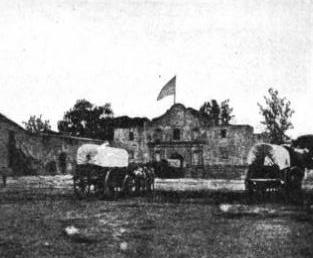
When I was about 10 years old, my poor, long-suffering Pawpaw took his wife, daughters and granddaughters on a two-week car trip through the America West. For those of you keeping tally, that’s one man trapped in a full-size van with seven females. Not only did he take us through Texas – stopping at today’s topic, the Alamo – but also visited New Mexico, Arizona, Oklahoma, North and South Dakota, Wyoming, Montana, Nebraska, Utah, Colorado, Arkansas, Missouri and south of the border to Mexico.
Since I am alive today and here writing this, I think it’s safe to assume that Pawpaw had the patience of a saint. That’s one man against seven women, 12 states and one politically unstable foreign country. Anyone who came through the experience without maiming an obnoxious, road-weary child pretty much could be trusted to negotiate peace in the Middle East.
Alas, I digress… this is about ghosts at the Alamo.
It was during my first visit to the Alamo that I saw something unexplained. As I mentioned, I was about 10 years old during that trip. I can remember parking in an adjacent lot to square in front of the old mission and walking across to the front entrance. Things were more relaxed back then. There was no formal line like there is now to enter. You just moseyed through at your own pace. If you had a question there were several park service folks there to answer you, but for the most part it was an informal, self-guided experience.
The first thing that struck me about the Alamo was how the temperature seemed to drop when we entered. It was more like being in a cool subterranean cave than an ancient house of worship. After filing through the main building – the iconic portion that comes to mind when you think of the Alamo – we exited backside into the main complex. I can remember walking with Pawpaw to the edge of a little stream-like waterway that cut through the middle of the property. In it there the largest gold fish I had ever seen.
I’m not sure where my mother and sisters were at that point. Probably in a bathroom somewhere. I’m pretty sure my grandmother was in the gift shop. My aunt and cousin were with them so it was just me and Pawpaw walking around the mission grounds. Ican remember him saying he wanted to show me the well that provided water to the Alamo. He fished in his pocket and pulled out a couple of coins for me to throw in and make a wish over.
As I was dangling over the old stone well, looking into the water and preparing to toss my coins, Pawpaw spoke.
“Look at that man,” he said in that calm, but assertive way of his.
I glanced up and looked toward the side of the building that house the gift shop and museum. Walking quickly, with purpose across the yard toward the side of that building was a man dressed how a working cowboy would. His entire body was dusty, as if he’d just ridden through the dessert. He was wearing brown chaps and had a gun slung around his hips. A cowboy hat tilted just over eyes, obscuring his features.
We’d already seen several character actors dressed as the Alamo defenders and Mexican attackers. One lady was giving a lesson on how they cooked during that era. Another man was talking about ammunition and guns near the battery. We just assumed this was another actor, reacting history. As we walked toward the man, my grandfather reached for his camera. I – being a camera hog – was going to get my picture with that cowboy, by god. Or so I thought.
Just as stepped onto the stone pathway, the man’s stride seemed to slow. He was nearing the side of the building and we assumed he was going to set up for some sort of historical presentation. But as the man approached wall he didn’t stop walking. He took one final step toward the building and disappeared. It was like he walked through a solid concrete wall.
Pawpaw and I stood there for a moment. I blinked a couple of times, assuming my eyes deceived me. Pawpaw just took my hand and led me toward the coolness of the shade. We sat there on a stone bench for a while and watched the people come and go. Pawpaw lit up a cigarette and smoked. My eyes wandered, looking for a glimpse of our traveling companions. We said nothing about the disappearing cowboy. Not that day. Not ever.
Was it the overactive imagination of a little girl? Perhaps. Something paranormal? Most would say not. In fact, I myself wrote the incident off. It was just something strange that I’d think of from time to time.
Fifteen years later I returned to the Alamo. This time I was a married woman, with a husband in tow. After a long, hot day on the River Walk, we decided to take a nighttime walking tour of the Alamo area.
Overall this was a pretty mundane event. They told us about the siege of the Alamo, the burning of the bodies in three points around the mission and all return of the Mexican Army to burn the remains of the mission to the ground.
Legend goes:
When the Mexican troops neared the church with flaming torches, six fully formed spirits suddenly appeared before the front doors of the mission, waving blazing sabers and yelling, "Do not touch the Alamo, do not touch these walls!" The Mexicans fled in fear and would not be persuaded to return regardless of threats made by their superiors. Some say these entities were Alamo defenders while others say they were monks protecting the mission.
Throughout the tour, our guide had pointed out different spots throughout the area that were thought to be haunted. A wide range of spirits are claimed to still call the location home – from Davy Crocket to John Wayne. (Read more on the ghosts here.) It was at this moment that I recalled the even from my childhood and I began listening intently to see if there was any mention of a cowboy ghost. Well, apparently there were several. One that walks through a cloister area and appears to be soaking wet and another that walks the roof line of the building.
I was a bit disappointed. Perhaps my memory had been false after all. Then as the group was about to disperse, the guide made one final comment – almost as an afterthought.
“Oh, there’s one more point of interest,” he said. “Visitors standing near the old well have reported a cowboy, in dusty clothing walk toward the secondary building. When the figure approaches the wall, he appears to walk through. If you look closely at the seams in the mortar, you can tell that a doorway used to be located there. This is the most frequently reported apparition.”
When we took the pictures on this trip we made sure that no other visitors were in the photo. When I saw this one I thought we had caught some one on the levee walkway by the river. But in the other picture taken seconds after this one there were no people. This photo is one that to me becomes clearer as it was enlarged. There was no break in the trees in this section of the walkway and absolutely no one there. The first picture shows what looks like an adult woman with a child in front of her. The second picture shows what appears to be a woman in a grey dress complete with a hat and a small boy walking in front of her.The first photo was taken about 100 yards away.
Each photo below shows the original photo and under it an enlargement of the area with an abnormality. The next two photos were taken on Highway 90 in Louisiana on a bayou. The corner of a house that was partly submerged is in the far right of the photo. In the second photo enlargement there appears to be a bald man leaning forward and looking toward the water. Photos by H. Murray.
This is the back of the Beauregard House taken from the levee walkway. None of the abnormalities were seen when the pictures were taken.The red mass is on the second floor near the center of the house.
The pictures below are of the front of the house. It was made about 60 yards from the house. On the left side of the house there seems to be a woman going into the shrubs. She appears to be bent forward.


 This photo below is not nearly as clear, but I thought it deserved to be shown. It appears to be a dark figure wearing a hat leaned against the building. It was not seen with the naked eye. You may form your own conclusions about what it is. The old building is definitely a spooky place that possible holds onto the day that Katrina emptied it of life and activity. At least the kind that it used to know.


 Some of the booths have prizes still hanging on the walls. And the figures that are left have changed from fun to sinister. Hurricane Katrina damaged the place and it has been deserted since. It's as if the owner took nothing and just walked away.

 Today the Ursuline Convent stores the Catholic Archives records dating back to 1718. In the 1700’s, the Catholic Diocese sent young girls from the French convents to New Orleans to spread Christian values and find respectable men to marry. They each carried a coffin shaped chest packed with their belongings. The chest was called a “casket” and the young women were mockingly called the Casket Girls. However, the plan backfired. A good number of the girls were raped and forced into prostitution. Ships sailed back to New Orleans to rescue the fair maidens and returned them to France. Some of the girls still carried the small caskets with them and the contents were never revealed. Legend says with the contents still unknown, the Sisters of the Ursuline placed them on the third floor of the convent. The doors and windows were sealed shut for all eternity. When the chests were finally opened many years later, they were found empty. Superstitious citizens claimed the girls had smuggled vampires into New Orleans in the chests instead of clothing and such. The sealed attic of the convent has shuttered windows. The heavy shutters are of an unique style not seen anywhere else within the French Quarter. The shutters are always closed, but they say late at night the shutters open and the vampires come out into New Orleans seeking their prey. The Ursuline Convent claims there is nothing stored in the third floor attic, but then these mysterious questions arise.
 The Lafitte Blacksmith Shop in The French Quarter still stands today.
 The Remains of Maison Rouge in Galveston.

 By the time of the American Civil War, Fort Pickens had not been occupied since the Mexican-American War. Despite its dilapidated condition, Lieutenant Adam J. Slemmer, in charge of United States forces at Fort Barrancas, determined that Pickens was more defensible than any of the other posts in the area. His decision to abandon Barrancas was hastened when, around midnight of January 8, 1861, his guards repelled a group of local men intending to take the fort. Some historians suggest that these were the first shots fired by United States forces in the Civil War. Shortly after this incident, Slemmer destroyed over 20,000 pounds of gunpowder at Fort McRee, spiked the guns at Barrancas, and evacuated about eighty troops to Fort Pickens. Shortly after that the Fort fell to the Union. Despite repeated Confederate military threats to it, Fort Pickens remained in Union hands throughout the Civil War.


 Jeremiah moved south from New England in December of 1824 to assume the light keeper duties at the Pensacola Light. The light keeper got married in 1826, and three children soon followed. Even with everyone who was able to do so pitching in to hunt and harvest the crops, there just never seemed to be enough food. This struggle to provide adequate food for everyone caused much stress and became the root cause of frequent heated and violent arguments between Jeremiah and his wife. Jeremiah's wife pressured him constantly, saying he wasn't doing enough, although he seemed to work endlessly.The constant tension and strife festered for the entire time the couple ran the Lighthouse - about 30 years. The children were all grown and on their own after 30 years, which left Jeremiah and his wife alone in the house. One night, the reason unknown to this day, Jeremiah's wife woke up in the middle of the night, went downstairs, and retrieved the sharpest knife she could find. Then she went back upstairs and stabbed her husband in the back. While watching him die, she formulated her alibi to make sure she would get away with it. She got rid of the incriminating evidence and reported her husband's death as a accident. Her plan was successful, and she soon took over tending the lighthouse. Her duties as light keeper we made nearly impossible by one malfunction after another. Countless mechanical problems, setbacks and malfunctions seemed to taunt the guilty wife every day. Was it the spirit of her murdered husband tormenting her? Stories say the murderous wife saw random things fly through the air, heard eerie laughter in empty rooms, saw shadows in the windows of the locked tower at night, frequently smelled the odor of pipe tobacco, and felt freezing cold blasts of air regardless of how hot the fireplace was burning. The Pensacola Lighthouse definitely seems to have the makings of a real haunted house. The bloodstain of Jeremiah's murder shows through the floorboards of the upstairs bedroom of the current keeper's house. It doesn't matter how hard it is scrubbed or what cleanser is used, the stain always comes back.
  A former light keeper's son said that when he used to pull the chains to keep the lens turning, he would hear breathing behind him. Visitors have their name eerily whispered into their ear by an unseen presence. Doors open and close by themselves, and footsteps are heard heading to the front door, the door would open and close, the footsteps then head out the door towards the gate, where the gate would open and close, then the footsteps would stop.
 Coast Guard crews can't keep the doors locked. They regularly lock them, double-check them, and come back to find them unlocked again. Many of them have experience the essence of the pipe smoke; one even reported actually seeing the smoke. Nearly everyone reports feeling another presence among them when they're in the tower. Still others are startled by the sudden slamming of the hatch to the lantern room, when they know no one is there. Just about everyone who is asked will say this is a real haunted lighthouse. One of the most convincing reports that this is a real haunted lighthouse happened in the late 1980s. The couple was asked to check the lighthouse to see why the light was out. When they got there, they heard a man pacing and cursing. The husband went upstairs to try to fix the light, while the wife remained downstairs listening to the unseen man ranting, raving, and swearing. At the exact moment the light came back on, the cursing and pacing abruptly stopped. Is it possible that Jeremiah was angry because the light was out and he couldn't fix it? This encounter probably provides the best evidence that this just may be a real haunted lighthouse.The Pensacola Light was fully automated in 1965. In 1971, the Gulf Islands National Seashore was created to help preserve the tower, as well as Forts Pickens and Barrancas which sit on neighboring land. The lighthouse tower and associated buildings were placed on the National Register of Historic Places in 1974.


 One film, which was decidedly not paranormal but which did encounter paranormal activity, was a television mini-series remake of The Long Hot Summer, starring Don Johnson, Cybill Shepherd, Ava Gardner and Jason




 Posts
Posts

